kristen@studioccd.com

On-Demand Staffing Web Design & Build2025

Two Front Doorsto one labour market

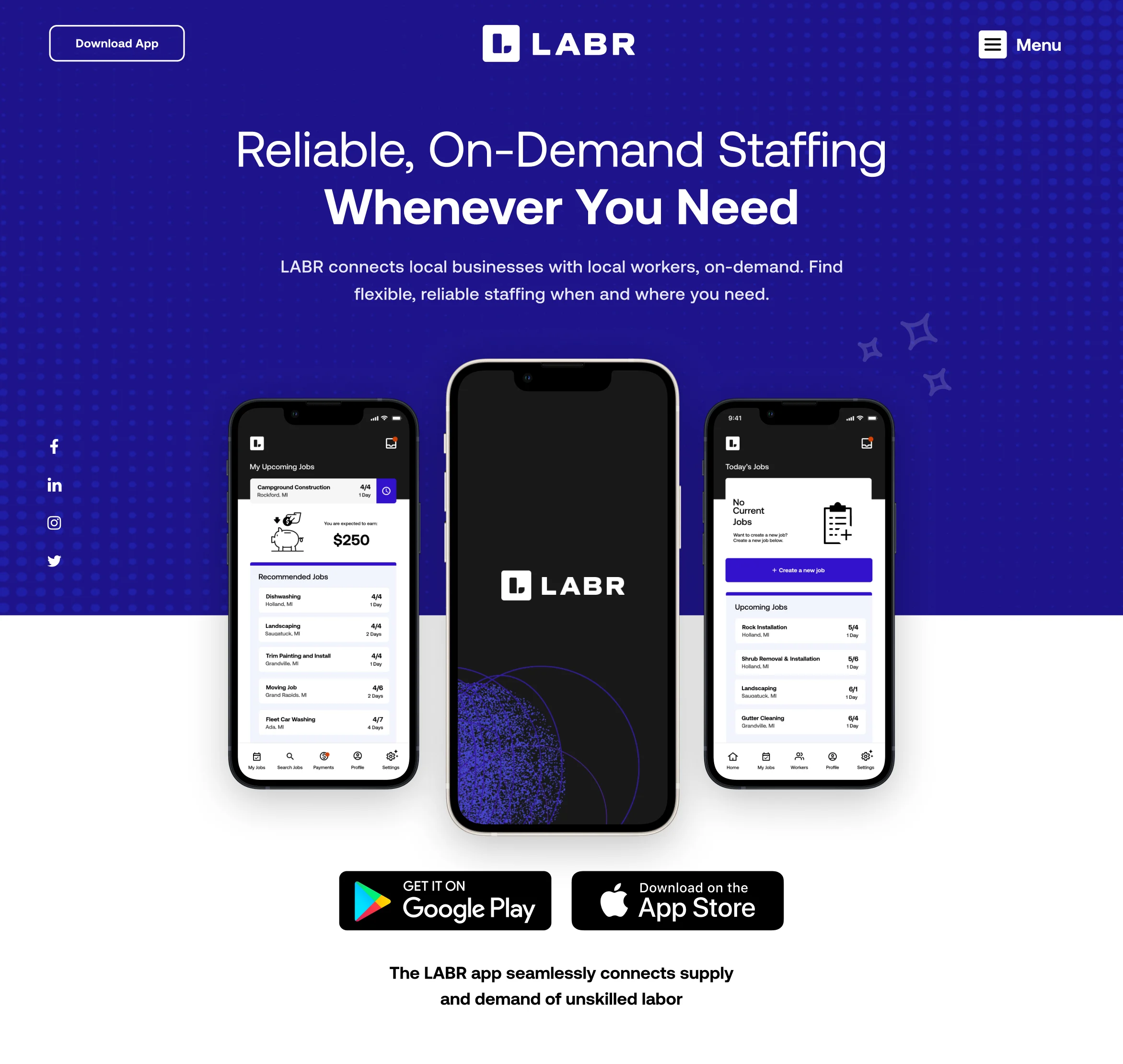
The LABR homepage hero: Reliable, On-Demand Staffing Whenever You Need on indigo, over three app screens showing upcoming jobs, the launch screen and job posting, with App Store and Google Play badges

LABR is an on-demand staffing platform: businesses post work that needs doing this week, and gig workers pick it up through the app. One platform, but two audiences who want opposite things from the same page — and a site that had to sell both without either reading as an afterthought.

LABR logo
Client
LABR
Year
2025
Scope
Web design and build
Surface
Marketing site, two audience paths

The brief

The Challenge

A platform like this only works when both sides turn up, which makes its marketing site an unusual brief: it has to run two arguments at once. A warehouse manager who needs six people on Saturday morning and a student looking for a shift that fits around classes are not the same visitor. A homepage that addresses both at once addresses neither.

The second problem is that none of this is a national market. Nobody searches for gig work in general — they search in Grand Rapids, in Kalamazoo, in Tulsa, and usually for a trade as well as a city. The site had to exist at that level of specificity without becoming a page count nobody could maintain.

And the product is an app, not a website. Every page here is a step toward a download that completes somewhere else, so the structure had to carry someone from a search result to an app store without losing track of which side they came in on.
How we worked

Approach

The Split At The Door

Helpers and Businesses separate in the navigation and stay separate after it. Each side gets its own page, its own hero and its own language — "Find Gig Jobs Near You" against "On-Demand Staffing Near You" — so a visitor lands inside the argument meant for them rather than a compromise between the two.

Grounds That Signal Side

The two paths are told apart before a word is read. The worker side runs on flat indigo; the business side runs on photography under a dark scrim. Same type, same components, same buttons — only the ground changes, which is enough to tell someone which half of the site they are standing in.

Templates, Not Pages

Locations and industries are built as templates rather than one-off pages, so Grand Rapids and Tulsa, construction and catering, are one layout with different content. Entering a new market becomes a content job instead of a design-and-build job, which is what lets the site follow the business into the next city.

One Exit

Every route ends in the same place. Download App sits in the header, beneath each hero, and in a closing band on every page — and the contact form splits one last time, "Looking for work?" beside "Need a hand?", so even the handoff still knows who it is handing off.

Design system

The System It Is Built On

LABR arrived with its identity already drawn, so the build worked to it rather than around it. A single indigo does everything colour does here — every primary button, every active state, every industry tag — set against near-black and two pale grounds that separate sections without introducing a second accent. Aeonik carries the headings in a mixed-weight lockup, where the regular and bold halves of one line do the emphasis a second typeface would otherwise be brought in for.

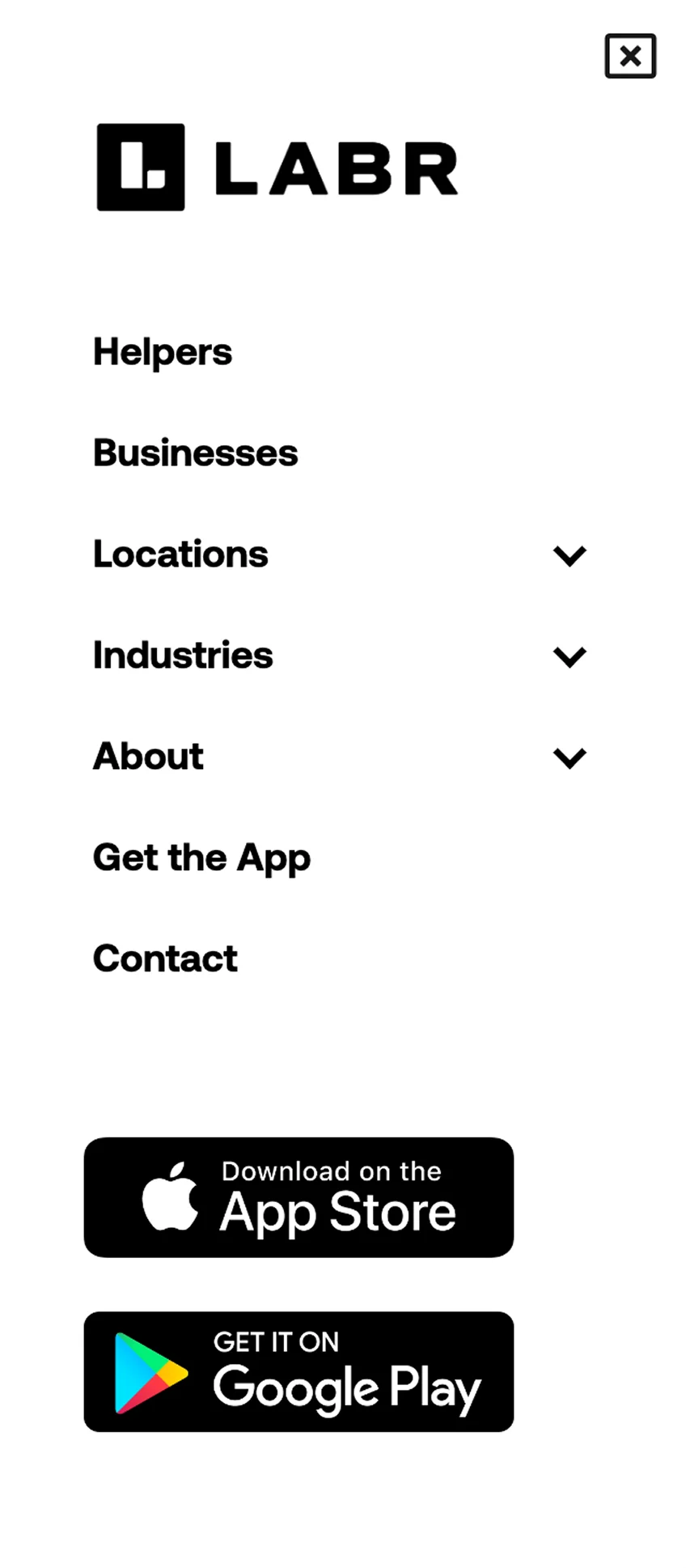
The LABR slide-out menu: a close control, the wordmark, then Helpers, Businesses, Locations, Industries, About, Get the App and Contact, with App Store and Google Play badges beneath

Typeface

Aeonik

AaRegularAaMediumAaBold
Indigo#3212CDAction
Near-black#181818Ground
Periwinkle#AEBFFFAccent
Mist#EEF0FAPanel

Design

The Site

Seven templates carry the whole site. The homepage pitches the platform itself, two more argue it from opposite sides, two repeat per city and per trade, and two close the loop — the mission behind the product, and the form that splits the enquiry one final time.

The LABR homepage: Reliable, On-Demand Staffing Whenever You Need, then How it Works for businesses and helpers, the featured industries, the cities served and the app download
Home — the proposition stated once, before the split
The LABR businesses page: On-Demand Staffing Near You, a Why LABR explainer, featured industries, the cities served, and a download band
Businesses — the employer argument, photographic and dark
The LABR helpers page: Find Gig Jobs Near You on flat indigo, with set-your-own-schedule benefits, industries and gig work locations
Helpers — the same structure on indigo, pitched at the worker
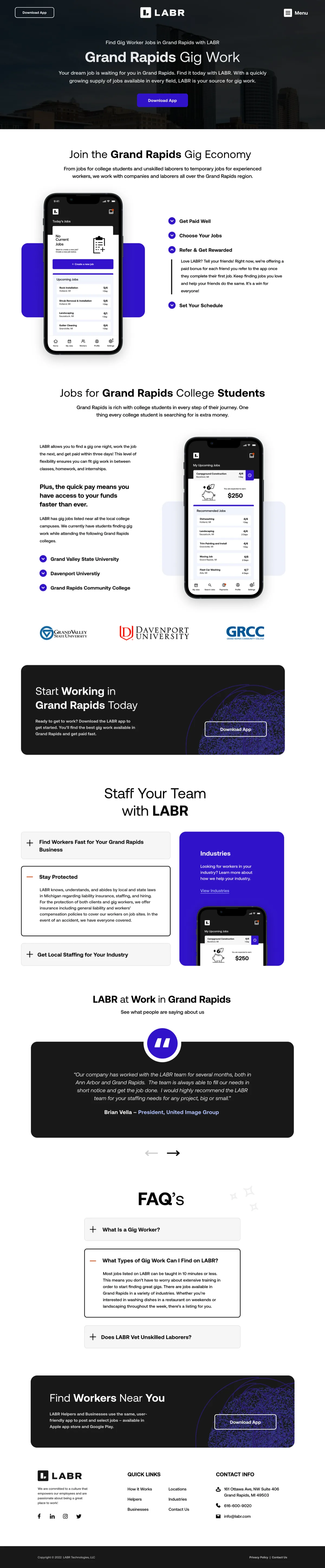
The LABR Grand Rapids location page, leading with Grand Rapids Gig Work over a city skyline and running through the local gig economy, industries and staffing
Locations — one template, nine metro markets
The LABR construction industry page: Find Construction Workers Near You Today, with the app shown filling construction jobs and the cities it covers
Industries — the same template cut by trade rather than city
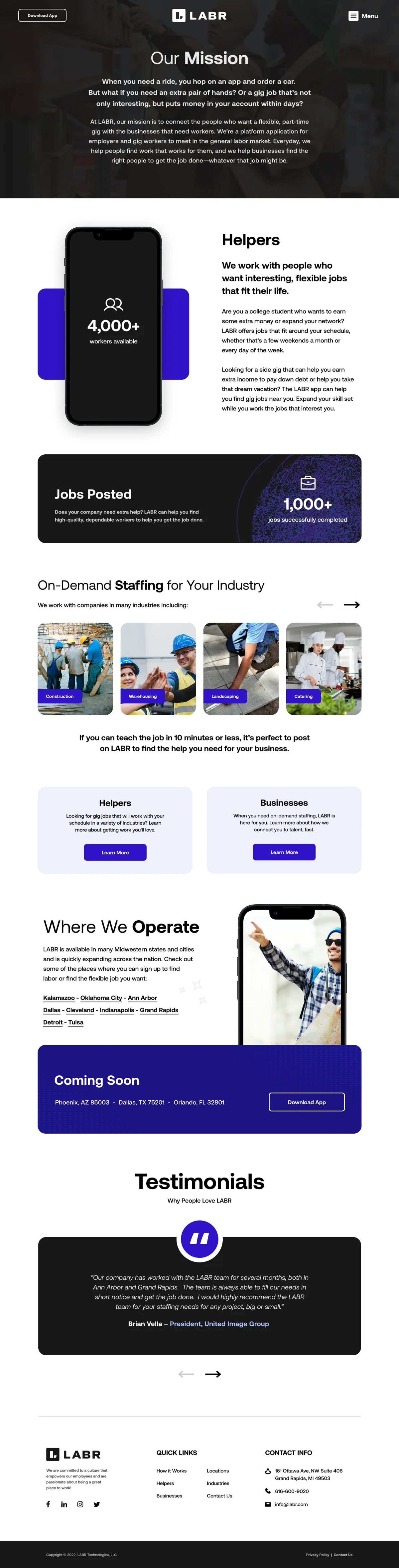
The LABR mission page, opening on Our Mission and running through the helper and business sides, how it works, the app and testimonials
Mission — the argument for the platform itself
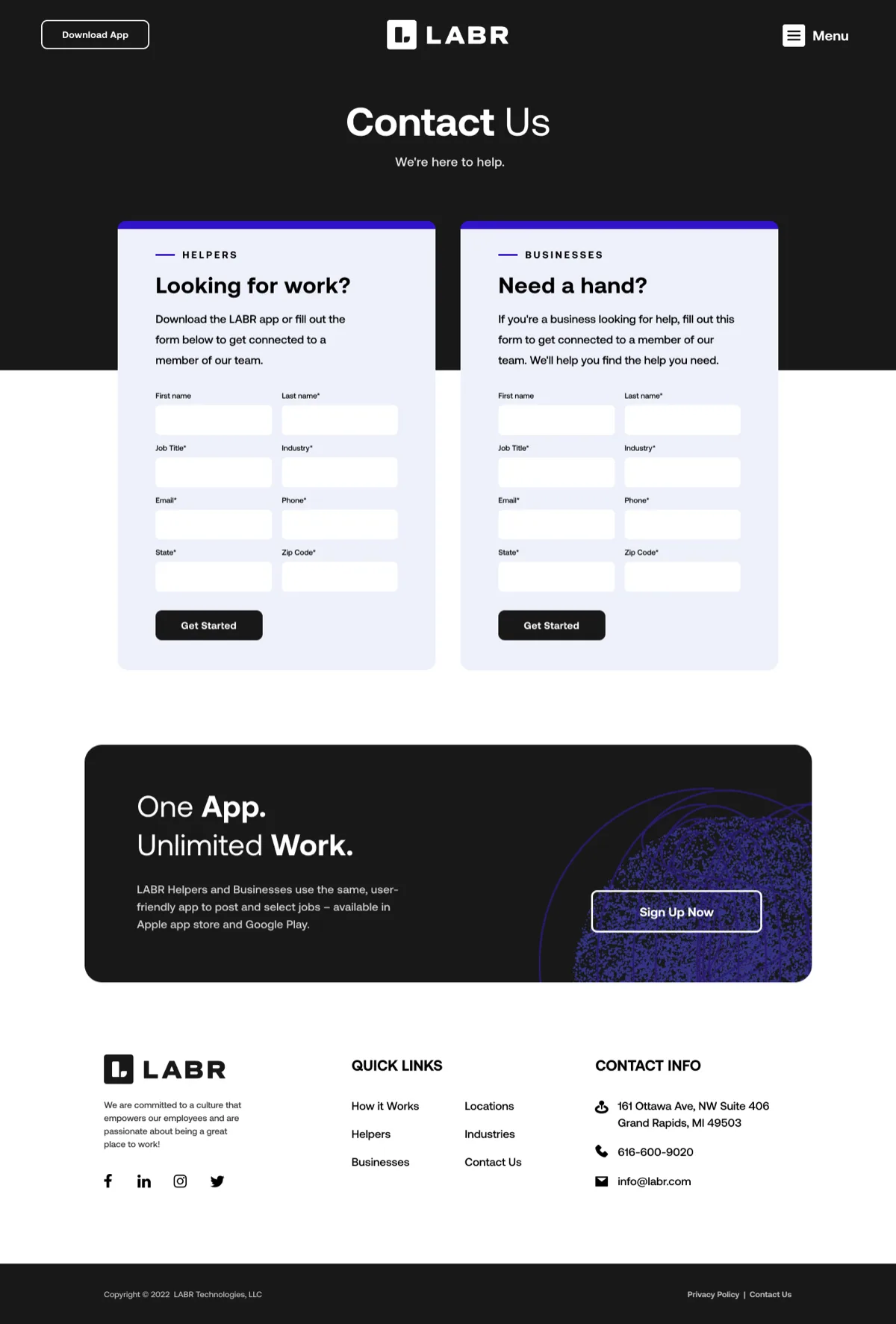
The LABR contact page with two forms side by side, Looking for work? for helpers and Need a hand? for businesses
Contact — the split held all the way to the form

Result

Outcome

The site launched carrying both sides of the platform across nine metro markets, with the location and industry templates repeating the same structure into each one. Adding a city or a trade is now a content task, which is the part that keeps paying as LABR expands.

The figures below are the platform’s own — the worker supply LABR had built and the markets it was operating in. They describe the platform the site was designed to hold, not a lift attributed to the build.

4,000+

Workers available on the platform

9

Metro markets, each with its own page

2

Audience paths through one site

4

Industries carried as templates

Services on this project

LABR ran through the same four phases we take every project through — discovery, strategy, design and build, then launch and beyond. Engagements are scoped against that method, and the monthly tiers are published rather than quoted blind.